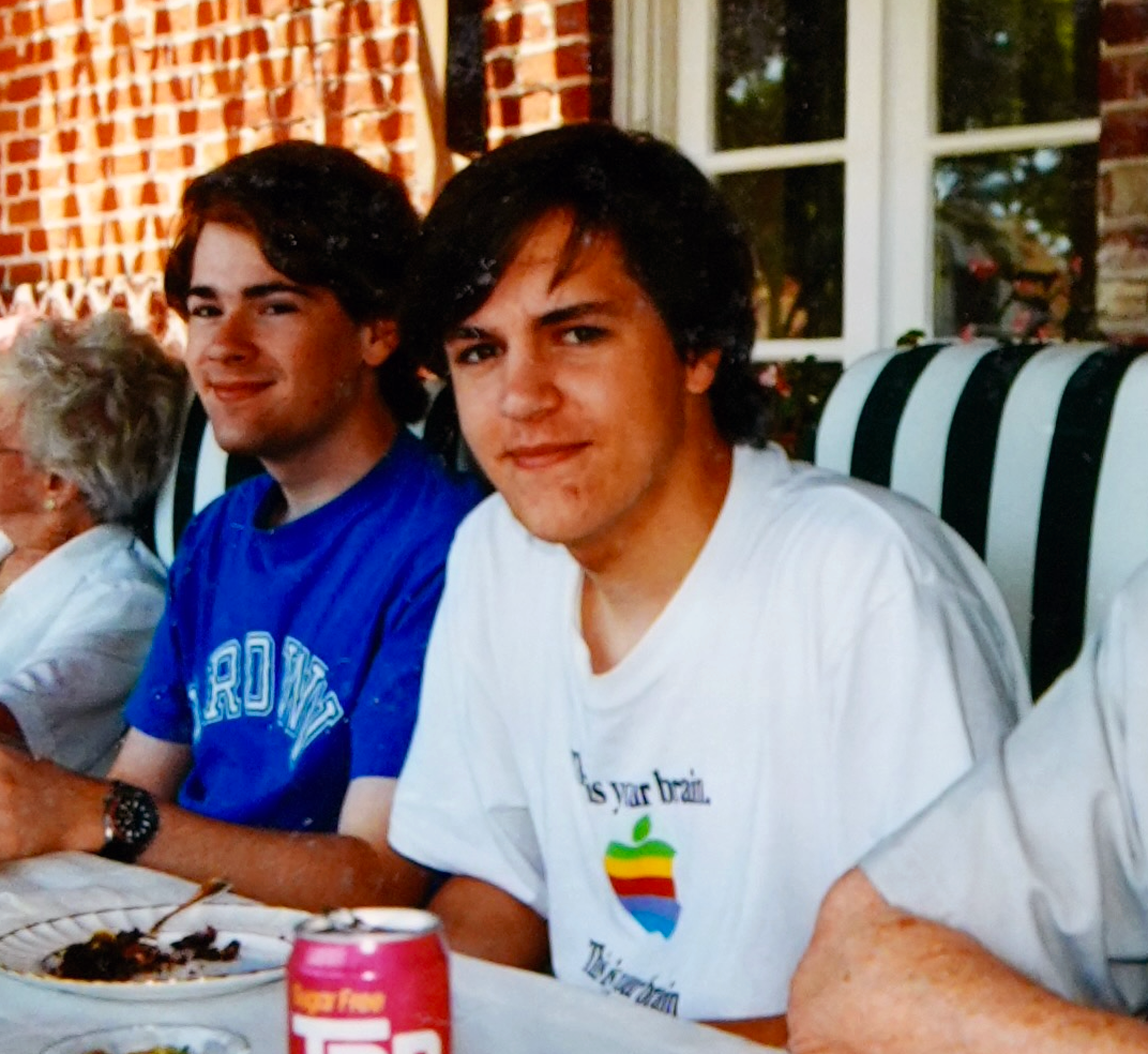
The Seed
A young Will Price discovers CompuServe — one of the earliest consumer online services, launched in 1979 out of Columbus, Ohio. Using a modem and a phone line, he dials in. Forums, chat, file libraries — and other people, at the other end of a phone line, at two in the morning.
CompuServe is expensive — hourly rates, long-distance charges — and it's centralized. You connect to their mainframes. But the idea takes root: what if anyone with a personal computer could run their own online community?
CompuServe launched its consumer service in September 1979 — among the first to offer email, chat, and file sharing to home computer users. Access cost $6/hour at 300 baud. The experience of connecting to a remote system through a telephone line would directly inspire what came next.
Inspiration: WWIV
By the mid-1980s, the BBS scene is thriving on IBM PCs. One system stands out: WWIV, written by Wayne Bell starting in late 1984. Originally a high school project in BASIC, WWIV evolves through Turbo Pascal and eventually C, becoming one of the most popular BBS packages on MS-DOS — known for its clean text interface, its "chain" system for external programs, and its own networking protocol, WWIVnet.
Will is running a Mac, and WWIV is DOS-only. What he wants is the part underneath: the command interface callers already know by muscle memory, and the external-program architecture that let other people extend somebody else's BBS. He wants it on a Macintosh, where the person running the board gets a proper Mac interface instead of a command prompt.
Created by Wayne Bell in late 1984 as an IBM PC/MS-DOS BBS. Distributed with source code, which encouraged a massive modding community. Its "chain" system for external programs — games, doors, utilities — was a direct influence on the Hermes external program API. WWIV remains active today as open-source software.

“I feel a lot of tact has to go into this introduction.”
He wrote twice. The first letter asked Wayne Bell for permission to use the WWIV command interface; Bell wrote back and said yes. The second, on 31 October 1989, thanked him and enclosed a printout of the Hermes startup code — a high-school student explaining to the author of WWIV why a Macintosh forces you to write a BBS as a state machine.
The first letter was later saved over with an unrelated Apple order and survived only in the unused space of the file that replaced it. It has been reassembled from those fragments.
Read both lettersOrigins
Will Price is in 10th grade at boarding school. He writes Hermes BBS in Lightspeed Pascal, the compiler later renamed THINK Pascal — a multi-line bulletin board system that lets Mac users dial in via modem, chat, share files, and play games. He develops it under the name AOC Software. The text interface for callers draws directly from WWIV's command style — with Wayne Bell's blessing — while the sysop gets a full graphical Mac interface to manage the board.
This is 1988. The web does not exist, email is not yet something ordinary people have, and a bulletin board is reached by dialing a telephone number and waiting through the handshake. Two thousand four hundred bits a second, one caller at a time, mostly local because long distance cost money.
From the very beginning, Hermes was designed for multi-node operation — supporting up to 10 simultaneous connections. Most BBS software of the era handled only one caller at a time. Hermes turned a single Macintosh into a small online community server.
First Public Release
Hermes is released publicly and starts turning up on other people's phone lines. Sysops run it on spare Macs in spare rooms, one modem at a time, then four, then ten.
Its author is at boarding school, where students are not allowed telephones. The workaround is a Telebit CellBlazer wired to an early cellular phone roughly the size of four bricks, with the antenna hung out of a dormitory window — in New England, in winter, in the snow — dialing the Olympus support board to answer users and push new builds. Dedication is not the problem.
Hermes was distributed as shareware — you could try it free, then register by dialing into the AOC Software BBS and purchasing a serial number directly through the terminal. This was e-commerce before the web existed.
The Rise
Hermes becomes the BBS that Mac sysops run. Not by marketing — there wasn't any — but because it was the one that behaved like Macintosh software, and because of the external program API, which let anyone else write the parts Will hadn't.
Dozens of externals follow — Blackjack, Slots, Checkers, trivia, voting booths, door games — written by people Will had never met, for boards he would never call.
- ▸ Multi-node operation (up to 10 simultaneous callers)
- ▸ ANSI terminal with full color support
- ▸ Fast ZModem file transfers (plus XMODEM, YMODEM)
- ▸ Message forums with threading
- ▸ Real-time multi-user chat
- ▸ External program API (games and utilities)
- ▸ Modem and AppleTalk (ADSP) networking
- ▸ TabbyNet and FidoNet mail network support
“Thirteen systems run the Hermes BBS package, a shareware product for Macintosh that can support up to ten lines.”
The Hermes copy protection used RSA-style public-key cryptography with 256-bit keys, built on a hand-rolled arbitrary-precision integer library with performance-critical inner loops written in inline Motorola 68000 assembly.
Because classic Mac OS used cooperative multitasking, the RSA computation couldn't block the event loop. So the validation ran incrementally in the background — a few iterations of square-and-multiply each time the BBS processed I/O — completing the full cryptographic proof over hundreds of event loop cycles while users stayed connected.
Anti-tamper mechanisms included code resource checksumming, a custom setjmp/longjmp stack capture mechanism in raw 68000 machine code (with its own runtime checksum), and subtle degradation rather than obvious failure — a pirated copy would appear to work but behave unreliably, making it hard for crackers to confirm they'd defeated the protection.
That incremental design is not a trick invented for the copy protection. It is the same constraint Will had described to Wayne Bell a year earlier, in the letter of 31 October 1989: on a Macintosh, every feature has to be built as stages that can be suspended and resumed, because the code must always hand control back. The cryptography simply became one more feature that had to wait its turn.
The complete system — all cryptographic source code, the BigInt library with 68K assembly, anti-tamper mechanisms, and pre-computed serial databases for every version — was open-sourced in February 2026.
The Sale
Will is in college by now, and Hermes has turned into a job — support calls, serial numbers, releases. He wants it to go to someone already inside the community rather than to a company that would treat it as a product. Lloyd Woodall, a well-known sysop, takes it on.
On April 17, 1993, Will signs Hermes BBS over to Woodall's Computer Classifieds in Bellevue, Washington. Version 2.2 is the last release under his name. That spring, at CERN, the World Wide Web is being put into the public domain; Mosaic ships in the autumn. Nobody in the BBS world is especially worried about either.
The final release by Will Price
Mercury Systems
Even as Hermes changes hands, Will isn't done with telecommunications software. He teams up with Mark Weaver, the author of NovaLink — another Mac BBS system — to form a company called Mercury Systems. Together they release MacIntercomm, a terminal program for the Macintosh.
MacIntercomm is notable for, among other things, keeping in-progress file transfers running even during interrupt time — solving the age-old problem of holding down a menu cancelling your downloads. The ambition is bigger: MacIntercomm is intended to evolve into a next-generation BBS. But both Will and Mark are in college, and the full vision doesn't materialize before the web changes everything. MacIntercomm is sold to New World Computing in 1994.
Hermes II
Lloyd Woodall renames the product "Hermes II" to mark the beginning of a new era. He employs developers Robert Rebbun (1993–?) and later David Woodall (?–1997) to continue the line. New features are added, the community continues to operate, and Hermes II boards stay online across the country.
And then the reason to dial a telephone number goes away. Netscape ships in 1994. AOL puts a disc in every magazine. By 1996 a trade columnist reviewing Hermes II is measuring it against the web and finding it old.
Lloyd Woodall
Computer Classifieds · Bellevue, WA
“Since acquiring the venerable Hermes Macintosh BBS program last Spring, new owner Lloyd Woodall of Computer Classifieds has developed a major upgrade package.”
“Hermes II by Computer Classifieds is a command-line interface package widely used by Macintosh sysops.”
“I’m so used to point and click that Hermes seems almost Jurassic, exciting as that can be for some.”
Arachnoware
Bill Dolinar of Arachnoware, in American Fork, Utah, owns Hermes for about a year and keeps developing it. It is the shortest of the four stewardships and by far the least documented — if you have anything from this period, it is the gap worth filling.
Bill Dolinar
Arachnoware · American Fork, UT
The Long Stewardship
Michael Alyn Miller acquires Hermes in 1998. What follows is the longest single period of ownership — over 25 years. He maintains hermesbbs.com, continues development through version 3.5.10b3, runs the "Olympus" support BBS — from Mountain View, California for most of that time, and from Redlands by the end — and integrates FidoNet support using Massimo Senna's Formula1 mailer.
The BBS era ends. Boards go dark, one at a time, and mostly nobody notices. Miller keeps the site up and the downloads working anyway, for twenty-six years.
Michael Alyn Miller
strangeGizmo.com · Mountain View → Redlands, CA
Continued development through v3.5.10b3. Ran the "Olympus" support BBS. Maintained hermesbbs.com for over two decades.
The Return
Thirty-one years after selling it, Will Price reacquires Hermes BBS from Michael Alyn Miller. All source code, trademarks, the hermesbbs.com domain, and all related materials return to their original creator.
The Hermes v2.2 source code — the original THINK Pascal and THINK C — is cleaned up, documented, and open-sourced on GitHub under the MIT license. After nearly 40 years, anyone can read, study, and build on the code.
Hermes 4
Hermes 4 is a native application for macOS and iOS, built with Apple's latest frameworks and designed for modern hardware. Real-time chat, forums, file sharing — and 68K emulation to run the original external programs on Apple Silicon.
The externals still work. A door game compiled for a 68000 in 1991 runs on Apple Silicon, unmodified, because the emulator underneath it is doing the same job the original Mac did — which is the whole point, and also the only part that was genuinely hard.
Currently in early development. Free beta available from this site.